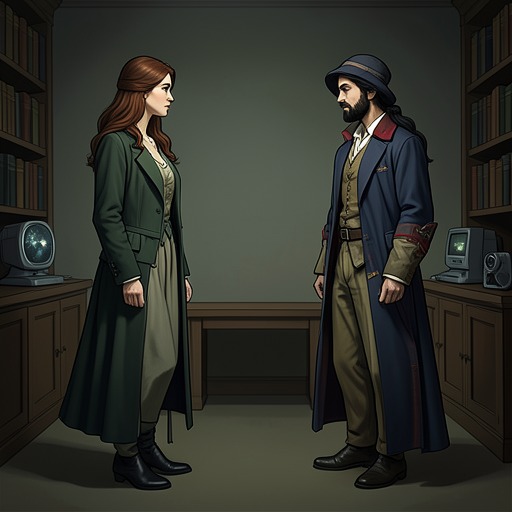
Mookse
Finnegans WakeMookse, also called Adrian in the fable’s narration, is the proud, bookish protagonist of “The Mookse and The Gripes.” His meeting with Gripes stages a clash between authority and vulnerability: Mookse answers a plea for assistance with scorn, doctrine, and a formidable display of learning, but the story ends by carrying both opponents away and leaving only a tree and a stone. The tale’s deliberately unstable language makes Mookse’s grandeur both comic and consequential.
Identity and Introduction
Mookse first appears as a solitary wanderer, established in an immense, lonely space as a figure set apart from ordinary company. After an elaborate meal and a ritualized preparation of his eyes, nostrils, ears, and throat, he leaves his dwelling, De Rure Albo, and sets out from Ludstown to investigate how badness might be understood. The scale of his surroundings and the ceremoniousness of his preparations turn a walk into a mock-epic undertaking.
He carries his father’s sword, a conspicuous inheritance that gives his outing the aspect of an armed expedition. The narrator describes him as fully equipped and monumental in bearing, already presenting him as a figure who trusts his own stature. The self-contained Mookse enters the episode not in search of a companion but intent on judging the world around him.
The Meeting at the Stream
After traveling only a short distance, Mookse reaches a stream near the turning of the Shinshone Lanteran. The water is personified as narrow, brown, and talkative, flowing with a voice of its own. Across it he sees Gripes, who is in a precarious condition: the fable portrays him as depleted and exposed to the consequences of his earlier troubles.
Mookse and Gripes face one another across the banks. Gripes addresses him with elaborate politeness and asks him to explain matters, presenting himself as a supplicant rather than a challenger. The exchange establishes the imbalance between them: Mookse occupies the position of apparent strength and security, while Gripes is the one who asks for help and has little power to compel it.
Authority, Refusal, and Display
Mookse rejects Gripes with a burst of insult and commands the surrounding followers to gather behind him. His response does not answer the request for assistance; it reasserts rank and separates him from the person asking. The fable makes contempt part of Mookse’s public performance, as the company around him reacts to his commanding voice.
When Gripes continues to plead, Mookse shifts from insult to an authoritative address. He presents himself as unable to save Gripes from death and declares his own side safe, invoking the security of the maternal home. His speech makes learning and institutional language instruments of distance: he claims the power to pronounce on Gripes’ condition while withholding aid. The assurance of his own safety is set against Gripes’ vulnerability, sharpening the moral and comic contrast between the two.
Mookse then assembles an imposing body of books and authorities to support his position. His display ranges across named thinkers and learned collections, and the narration emphasizes the labor of proof as well as its grandiloquent effect. The episode gives Mookse’s confidence a material form in the volumes gathered before him, but the surrounding wordplay keeps his intellectual supremacy from becoming straightforwardly credible.
Separation and Narrative Role
As darkness deepens, both figures lose something of their earlier command: the narration presents Mookse as able to see but not hear well, and Gripes as able to hear but not see well. Each remains absorbed in his own expectation of what will follow, while the failing light makes their separation increasingly absolute. Their encounter does not resolve into mutual understanding or reconciliation.
At the end, a woman arrives at each bank and carries Mookse and Gripes away to separate unseen dwellings. Mookse is taken up with solemn reverence; Gripes, described as panicked, is also removed from his bank. The narrator explicitly distinguishes their fates in tone, presenting Mookse as having had reason and Gripes as having gone wrong, but neither remains in the landscape. Only an elm tree and a stone are left. The contrast preserves Mookse’s apparent advantage while making the outcome less like a conventional triumph than a departure into separate, unexplained destinies.
As an episode, Mookse’s encounter with Gripes turns a meeting across water into a contest over who may speak with authority and who must ask for mercy. Mookse’s confidence is grounded in inherited weaponry, rank, and accumulated learning; the fable places those signs of power beside his refusal to help. Its final removal of both figures, followed by the image of the tree and stone, leaves their opposition suspended in the story’s shifting, cyclical world rather than settled by a clear verdict.